PS - Precision Score
The Precision Score (PS) (also known as Positive Predictive Value) is the ratio of correctly predicted positive observations to the total predicted positive observations.
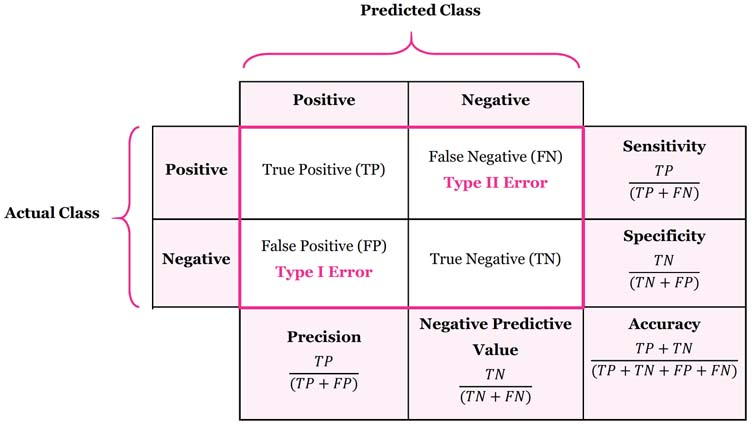
Intuitively, precision represents the ability of the classifier not to label a negative sample as positive. It answers the critical question: “Of all the samples predicted as positive, how many were actually positive?”
Where:
\(TP\) (True Positives) is the number of correctly predicted positive instances.
\(FP\) (False Positives) is the number of negative instances incorrectly predicted as positive.
Averaging Strategies (Multiclass / Multilabel)
When handling more than two classes, precision is calculated per class and then aggregated using one of the following average parameters:
None: Returns an array/dictionary of precision scores for each individual class.
macro: Calculates the unweighted arithmetic mean of the precision scores across all classes. It treats all classes equally, regardless of class frequency.
micro: Calculates globally by aggregating the total true positives and false positives across all classes: \(\frac{\sum TP}{\sum TP + \sum FP}\).
weighted: Calculates precision for each class and finds their average weighted by support (the number of true instances for each class). This accounts for class imbalance.
Properties
Best possible score:
1.0(Higher value is better, indicating zero false positives).Worst possible score:
0.0Range:
[0.0, 1.0]
Example Usage
from permetrics.classification import ClassificationMetric

# ==============================================================================
# SCENARIO 1: Binary Classification
# The default 'binary' mode requires a specific positive class (pos_label)
# ==============================================================================
print("--- 1. BINARY CLASSIFICATION EXAMPLES ---")

y_true_bin = [0, 1, 0, 0, 1, 0]
y_pred_bin = [0, 1, 0, 0, 0, 1]
cm_bin = ClassificationMetric(y_true_bin, y_pred_bin)

# 1. Default configuration: average="binary", pos_label=1
ps_bin_default = cm_bin.PS()
print(f"Default (average='binary', pos_label=1): {ps_bin_default}")

# 2. Change pos_label to 0 (treats 0 as the positive class)
ps_bin_pos0 = cm_bin.PS(average="binary", pos_label=0)
print(f"Binary with pos_label=0                : {ps_bin_pos0}")

# 3. When average=None, it returns independent scores for each class found
ps_bin_none = cm_bin.PS(average=None)
print(f"Binary with average=None               : {ps_bin_none}")

# ==============================================================================
# SCENARIO 2: Multiclass Classification with Integer Labels
# ==============================================================================
print("\n--- 2. MULTICLASS (INTEGER LABELS) EXAMPLES ---")

y_true_multi_int = [0, 1, 2, 0, 1, 2, 0, 2]
y_pred_multi_int = [0, 2, 1, 0, 1, 1, 0, 2]
cm_multi_int = ClassificationMetric(y_true_multi_int, y_pred_multi_int)

print(f"average=None       : {cm_multi_int.PS(average=None)}")
print(f"average='macro'    : {cm_multi_int.PS(average='macro')}")
print(f"average='micro'    : {cm_multi_int.PS(average='micro')}")
print(f"average='weighted' : {cm_multi_int.PS(average='weighted')}")

# Using the `labels` parameter to filter specific classes
print(f"Filter classes [1, 2] (average=None)    : {cm_multi_int.PS(labels=[1, 2], average=None)}")
print(f"Filter classes [1, 2] (average='macro')   : {cm_multi_int.PS(labels=[1, 2], average='macro')}")
print(f"Filter classes [1, 2] (average='micro')   : {cm_multi_int.PS(labels=[1, 2], average='micro')}")
print(f"Filter classes [1, 2] (average='weighted'): {cm_multi_int.PS(labels=[1, 2], average='weighted')}")

# ==============================================================================
# SCENARIO 3: Multiclass Classification with Categorical/String Labels
# ==============================================================================
print("\n--- 3. MULTICLASS (CATEGORICAL/STRING LABELS) EXAMPLES ---")

y_true_str = ["cat", "ant", "cat", "cat", "ant", "bird", "bird", "bird"]
y_pred_str = ["ant", "ant", "cat", "cat", "ant", "cat", "bird", "ant"]
cm_str = ClassificationMetric(y_true_str, y_pred_str)

print(f"average=None (Class dict) : {cm_str.PS(average=None)}")
print(f"average='macro'           : {cm_str.PS(average='macro')}")
print(f"average='micro'           : {cm_str.PS(average='micro')}")
print(f"average='weighted'        : {cm_str.PS(average='weighted')}")

# Filter string labels: Focus calculation entirely on 'cat' and 'bird'
print(f"Filter 'cat' & 'bird' (average=None)    : {cm_str.PS(labels=['cat', 'bird'], average=None)}")
print(f"Filter 'cat' & 'bird' (average='macro')   : {cm_str.PS(labels=['cat', 'bird'], average='macro')}")
print(f"Filter 'cat' & 'bird' (average='micro')   : {cm_str.PS(labels=['cat', 'bird'], average='micro')}")
print(f"Filter 'cat' & 'bird' (average='weighted'): {cm_str.PS(labels=['cat', 'bird'], average='weighted')}")